
Resources
Practical tools, reflections and examples from Cultivating Safe Spaces and Human Infrastructure Practice.
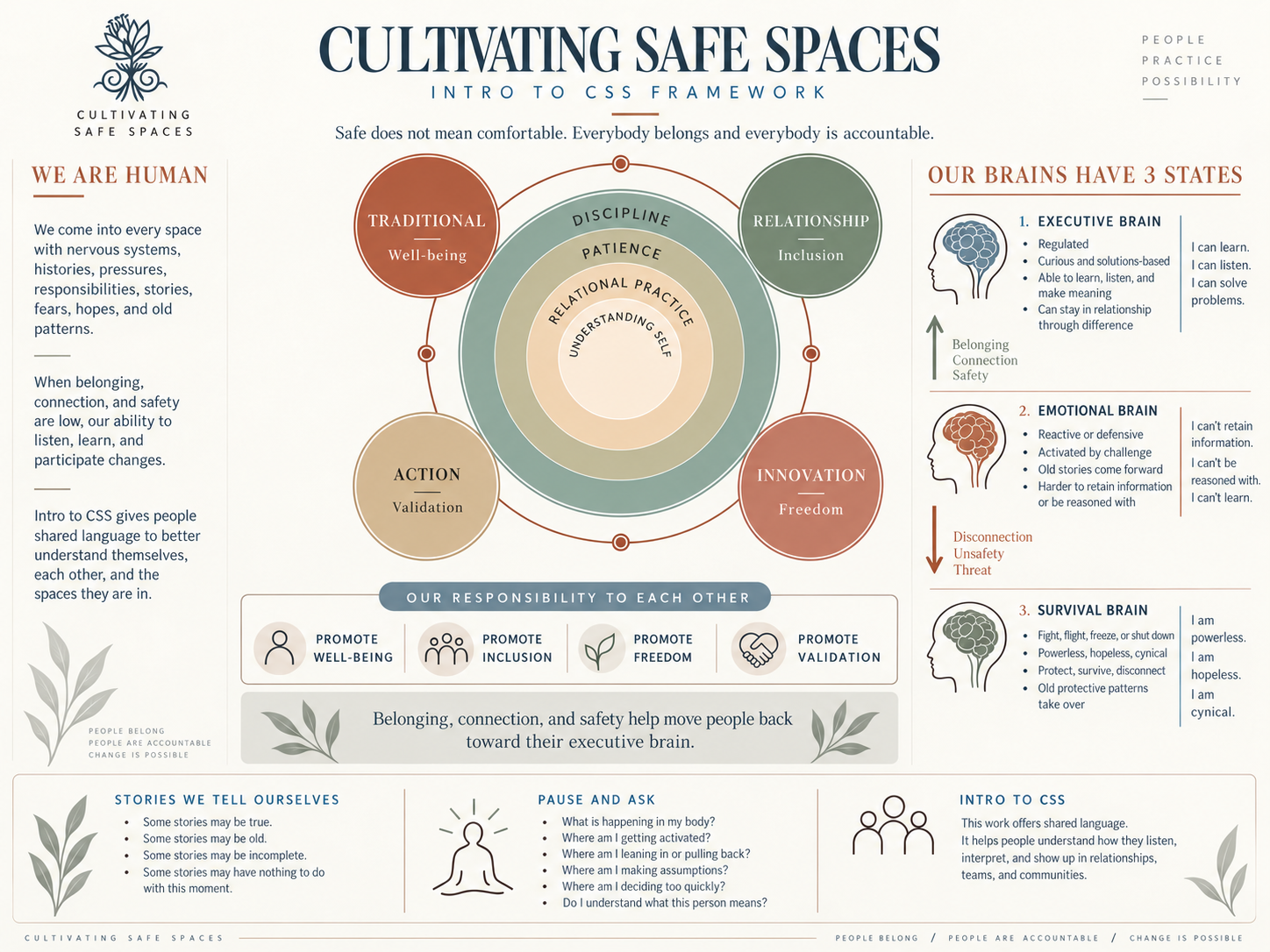
This is a growing collection of resources developed through Cultivating Safe Spaces sessions, Human Infrastructure Practice, professional development, organizational work and ongoing practice.
Some are simple tools you can use in a meeting. Others are reflections, summaries or examples of how the work can be applied to leadership, governance, organizational change, relationships, decision-making and complex systems.
Cultivating Safe Spaces helps strengthen the human capacity required to work through complexity, difference and change.
Human Infrastructure Practice brings that same architecture into larger organizational, institutional and systems environments.
The goal is not to give people more theory to admire from a safe distance. It is to share useful language, questions and practices that can help people work through real things.
Featured Resource
CSS Professional Development Day Summary
A practical summary from a full-day Cultivating Safe Spaces Professional Development session focused on leadership, governance, organizational change, accountability, decision-making and difficult conversations.
The session applied CSS to real situations participants were navigating and surfaced practical questions such as:
What problem are we actually trying to solve?
Do we agree that this is the problem?
What belongs to me, and what belongs to someone else?
What conditions are missing?
Are we dealing with awareness, discussion, decision or action?
What perspective is present? What perspective is missing?
Has the organization outgrown the way we currently work?
The summary also explores shared language, structure and relationship, predictable pressure, accountability, leadership communication and the Four Necessary Conditions in practice. CSS Professional Development Da… CSS Professional Development Da…
Read the Professional Development Day Summary
This resource reflects themes and learning from one CSS Professional Development Day. It is shared as an example of how Cultivating Safe Spaces can be applied to real organizational, leadership and governance challenges. Participant identities and specific organizational details have been removed.
Human Infrastructure Practice
Human Infrastructure Practice looks at the conditions people need in order to lead, decide, collaborate, adapt and remain in relationship inside complex systems.
It asks questions such as:
Do people have the capacity to operate the systems we have built?
Are the conditions around the work helping or hindering people?
What problem are we actually trying to solve?
Where are relationships, roles or authority unclear?
What happens to decision-making under pressure?
What human capacity is required for this system to work well?
This work applies the CSS architecture at larger scales, including teams, leadership, organizations, communities, institutions and systems.
More Resources Coming
We will continue adding:
CSS practice tools
Human Infrastructure Practice reflections
leadership and decision-making resources
meeting and governance tools
shared language exercises
session summaries
facilitator resources
examples from organizational and systems work
Better systems still depend on people.
And at the centre of both Cultivating Safe Spaces and Human Infrastructure Practice is the same question:
What human capacity is required for people to do difficult, important work well?